Archives

All materials presented within this page are offered as invitations, not prescriptions. They are intended to support reflection, education, creative growth, and spiritual formation, while honoring the responsibility of the individual to discern wisely and engage thoughtfully. The following books were instrumental in my personal development and spiritual formation.
Recommended Reading List: For Personal Development
Aion: Researches into the Phenomenology of the Self
Aion: Researches into the Phenomenology of the Self (1951) is a major work of analytical psychology by Carl Gustav Jung. It is Volume 9, Part II, of Jung’s Collected Works, and one of his most complex explorations of the psyche, addressing the symbolism of the Self through mythological, religious, and alchemical imagery.
In Aion, Jung:
Explicitly uses the term “shadow”
Defines it as the unconscious, rejected, inferior, or unintegrated aspects of the personality
Links the shadow to:
Moral development
Projection
Evil and self-righteousness
Individuation
Places the shadow in direct relationship to:
The ego
The Self
Religious symbolism (especially Christian imagery)
One of Jung’s most cited ideas comes from Aion:
“One does not become enlightened by imagining figures of light, but by making the darkness conscious.”
While Aion is the clearest, Jung also treats the shadow in:
Two Essays on Analytical Psychology
– Early formulation of shadow concepts within ego developmentThe Archetypes and the Collective Unconscious
– Places the shadow among archetypal structuresPsychology and Religion
– Connects shadow integration with religious experience and moral struggle
Science of Being and Art of Living
by Maharishi Mahesh Yogi
This is the primary and foundational book in which Maharishi explicitly defines what he means by “Being” and systematically lays out its relationship to mind, consciousness, thought, action, and fulfillment.
In Science of Being and Art of Living, Maharishi:
Defines Being as the unbounded, eternal, absolute reality underlying all mental and physical phenomena
Distinguishes Being from:
Thinking
Emotion
Personality
Moral striving alone
Presents Being as:
The source of thought
The ground of consciousness
The basis of peace, creativity, and order
Introduces the central pedagogical claim:
That direct experience of Being (via Transcendental Meditation) is necessary—not merely intellectual understanding
Frames enlightenment as:
The stabilization of awareness in Being
Followed by right action naturally flowing from that state
“The field of pure Being is the source of all thought, all creativity, and all happiness.”
Dao De Jing
by Laozi
This is the primary and foundational text in which the Dao (Tao) is explicitly named, described, and contemplated. All later Daoist philosophy, cosmology, ethics, and practice flow from this work.
In the Dao De Jing, Laozi:
Introduces the Dao as:
The ineffable, eternal source of all things
Prior to language, form, morality, and conceptual thought
Distinguishes the Dao from:
Social conventions
Moralism
Forceful striving
Artificial order
Describes the Dao as:
Self-ordering
Non-coercive
Generative rather than controlling
Establishes wu wei (non-forcing, effortless action) as the proper mode of alignment with reality
Presents virtue (De) not as imposed morality, but as natural efficacy arising from harmony with the Dao
“The Dao that can be spoken is not the eternal Dao.”
The Kybalion
by Three Initiates
(commonly attributed to William Walker Atkinson)
This is the primary modern text that systematically presents Hermetic principles for a contemporary audience. While it is not an ancient manuscript itself, The Kybalion functions as a synthetic exposition of Hermetic metaphysics, psychology, and cosmology.
In The Kybalion, the authors:
Explicitly articulate the Seven Hermetic Principles:
Mentalism – All is Mind
Correspondence – As above, so below
Vibration – Nothing rests; everything moves
Polarity – Everything has poles
Rhythm – All things rise and fall
Cause and Effect – Nothing happens by chance
Gender – Generative forces are present in all things
Present Mind as the substrate of reality, rather than matter
Emphasize conscious mastery over reaction through understanding law
Frame spiritual development as:
Knowledge of universal principles
Intentional application
Mental discipline rather than surrender or transcendence alone
“The Universe is Mental—held in the Mind of THE ALL.”
The Imitation of Christ
by Thomas à Kempis
This is the primary and most influential devotional work in Christian history outside of Scripture itself. It articulates with disciplined clarity what it means to conform one’s inner life to Christ, emphasizing humility, obedience, repentance, and love over speculation or metaphysical mastery.
In The Imitation of Christ, Thomas à Kempis:
Centers the spiritual life on Christlikeness, not enlightenment or self-mastery
Frames transformation as:
Submission of the will
Mortification of pride
Patience in suffering
Emphasizes interior formation over external display of religion
Treats knowledge as subordinate to:
Love
Obedience
Holiness
Presents spiritual maturity as:
Dying to self
Bearing the cross
Trusting God amid obscurity
“If thou wilt receive profit, read with humility, simplicity, and faith.”

The Conference of the Birds
by Farid ud-Din Attar
This is the central allegorical masterpiece of Sufi literature, presenting the spiritual journey of the soul toward God through poetic narrative, symbolism, and moral instruction. It remains one of the most influential works of Islamic mysticism ever written.
In The Conference of the Birds, Attar:
Uses an extended allegory in which birds represent human souls
Portrays the spiritual path as a dangerous, demanding journey rather than instant illumination
Describes seven valleys of spiritual transformation:
Seeking
Love
Knowledge
Detachment
Unity
Bewilderment
Poverty and Annihilation
Emphasizes:
Self-emptying
Loss of ego
Endurance through suffering
Culminates in the realization that the divine king Simurgh is discovered through the transformation of the seekers themselves
“The journey is hard; the road is long. But the reward is union.”
Haṭha Yoga Pradīpikā
by Svātmārāma
(15th century, Nāth Yoga tradition)
This is the foundational manual of classical Haṭha Yoga, synthesizing earlier yogic teachings into a practical system aimed at physical purification, energetic control, and preparation for higher states of meditation.
In the Haṭha Yoga Pradīpikā, Svātmārāma:
Presents Haṭha Yoga as a means, not an end
Defines the body as:
A necessary instrument for liberation
Something to be disciplined, purified, and stabilized
Systematically teaches practices including:
Āsana (posture)
Prāṇāyāma (breath regulation)
Mudrā (energetic seals)
Bandha (locks)
Describes kuṇḍalinī awakening as the result of proper practice
Frames Haṭha Yoga as preparation for Rāja Yoga (deep meditative absorption)
“Haṭha Yoga is a staircase to Rāja Yoga.”
The Hidden Way Across the Threshold
by J. C. Street
(early 20th century)
This is a rare and highly esoteric Christian mystical work that attempts to articulate the interior, initiatory dimension of Christian salvation—what the author understands as the hidden mystery of regeneration, transformation, and union with Christ.
In The Hidden Way Across the Threshold, Street:
Interprets Christianity as an inner path of spiritual rebirth, not merely doctrinal assent
Frames salvation as:
A process of interior death and resurrection
An experiential crossing of a spiritual “threshold”
Draws heavily on:
Pauline language (especially “Christ in you”)
Johannine mysticism
Allegorical interpretation of Scripture
Emphasizes initiation, illumination, and regeneration
Treats the Christian life as a hidden work of transformation rather than external religiosity
The Kingdom of God is entered inwardly, through a death to the old self and the awakening of the Christ-life within.


In Search of Love and Wisdom
by G. E. Poesnecker
(20th century)
This work functions as a concise Rosicrucian synthesis of moral philosophy, metaphysics, and spiritual aspiration, presenting the human search for meaning as a quest grounded in love, wisdom, and ethical refinement rather than dogma or purely intellectual abstraction.
In In Search of Love and Wisdom, Poesnecker:
Frames spiritual development as a balanced pursuit of heart and intellect
Defines love as:
The harmonizing force of human relations
The moral measure of spiritual maturity
Defines wisdom as:
Knowledge refined by experience
Understanding aligned with ethical responsibility
Emphasizes:
Self-knowledge
Moral discipline
Service to others
Draws from:
Western esotericism
Classical philosophy
Mystical Christianity (implicitly, rather than confessionally.
Wisdom without love becomes cold abstraction; love without wisdom becomes blind sentiment.
Rhetoric
by Aristotle
(4th century BCE)
This is the foundational Western treatise on persuasion, argumentation, and public discourse. Rhetoric systematically examines how speech shapes belief, judgment, and action within civic, ethical, and communal life.
In Rhetoric, Aristotle:
Defines rhetoric as the faculty of discovering the available means of persuasion in any given situation
Establishes the three classical modes of persuasion:
Ethos – credibility and moral character of the speaker
Pathos – emotional disposition of the audience
Logos – logical structure and reasoning of the argument
Treats persuasion as:
Morally neutral in itself
Ethically dependent on the character and intention of the speaker
Analyzes:
Emotions and their causes
Types of audiences
Forms of argument and fallacy
Integrates rhetoric with:
Ethics
Politics
Practical wisdom (phronēsis
“Rhetoric is a counterpart of dialectic.”
Pistis Sophia
translated and interpreted by G. R. S. Mead
(original Coptic text, likely 3rd–4th century; modern scholarly transmission late 19th–early 20th century)
This work is the most extensive surviving Gnostic-Christian scripture, presenting an esoteric cosmology, mythic theology, and initiatory soteriology framed as post-resurrection teachings of Jesus to His disciples.
In Pistis Sophia:
Jesus reveals hidden teachings to an inner circle of disciples
Salvation is portrayed as:
Ascent of the soul through multiple heavenly realms
Liberation from archons, powers, and cosmic rulers
Sophia (Wisdom) falls from the divine realm and must be:
Purified
Redeemed
Restored through repentance and gnosis
Knowledge (gnōsis) is emphasized as:
Salvific
Initiatory
Necessary for ascent
Scripture, prayer, and ritual are reinterpreted through a cosmic-mythological lens.
Is dialogical, presented as extended questions and answers between Jesus and the disciples
Uses:
Myth
Numerology
Angelology
Cosmic geography
Reinterprets biblical figures symbolically rather than historically
Assumes graded spiritual advancement, not universal accessibility
Mead’s contribution is significant: he frames the text sympathetically while attempting scholarly clarity, situating it within the broader Gnostic revival and comparative religion movement of his time
“Wisdom descends into chaos and must be raised again through knowledge, repentance, and divine aid.”
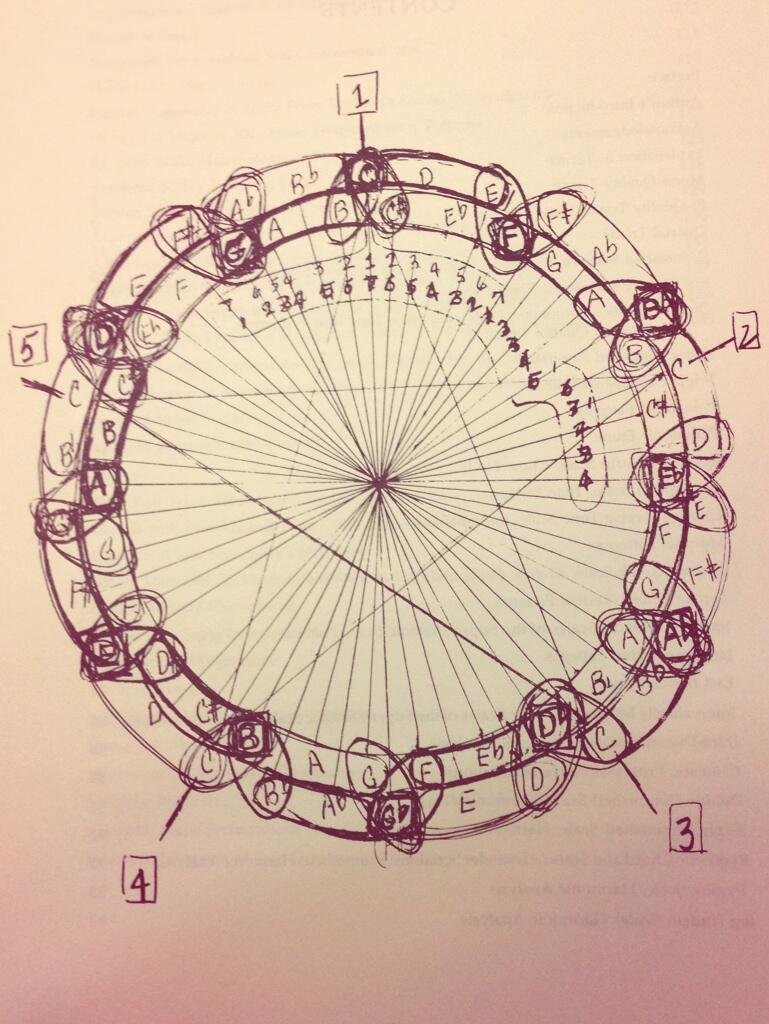
Coltrane’s drawing, as preserved by Yusef Lateef, is not only a theory diagram but a sacred map of sound, showing music as a unified, living, spiritual system.
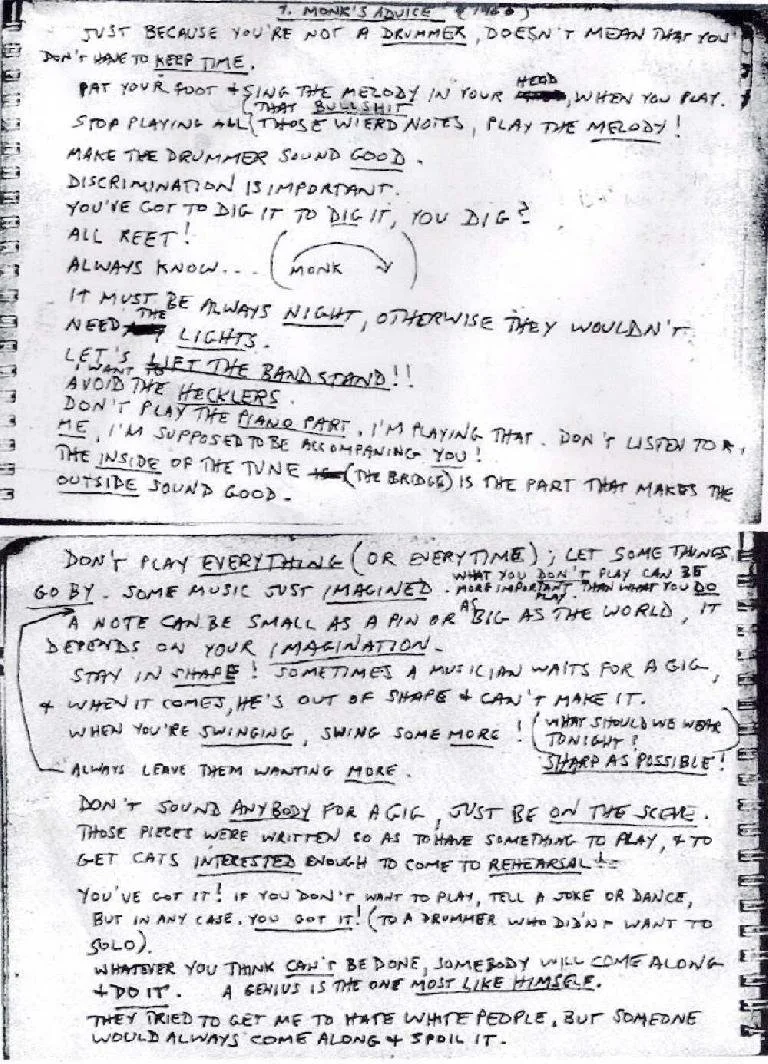
Thelonius Monk’s advice to musicians
Leading an Inspired Life
by Jim Rohn
(20th century, personal development and leadership tradition)
This work functions as a distilled statement of Jim Rohn’s life philosophy, presenting inspiration not as emotion or mysticism, but as the result of disciplined thinking, ethical responsibility, and intentional living.
In Leading an Inspired Life, Rohn:
Defines inspiration as:
The fruit of character, not circumstance
A byproduct of order, purpose, and values
Emphasizes:
Personal responsibility as the foundation of freedom
Self-discipline as the gateway to opportunity
Frames success as:
Inner alignment before external achievement
Becoming more rather than merely having more
Treats leadership as:
Influence rooted in example
The overflow of a well-governed life
Integrates:
Practical wisdom
Moral clarity
Long-term visio
“Success is nothing more than a few simple disciplines practiced every day.”
The Universal One
by Walter Russell
(1926) cosmological philosophy, metaphysical science
This work is Walter Russell’s foundational cosmological treatise, presenting a unified vision of reality that seeks to reconcile science, metaphysics, art, and spirituality through a single governing principle of rhythmic balance.
In The Universal One, Russell:
Proposes a unified cosmology grounded in:
Rhythm
Balance
Polarity
Describes the universe as:
A motion-based manifestation of an underlying stillness
Governed by wave mechanics rather than material substance
Frames creation as:
Cycles of compression and expansion
Electric polarization and depolarization
Presents Light not merely as illumination, but as:
The generative principle of form
The organizing intelligence of the cosmos
Interprets consciousness as:
Central, not emergent
The directing force behind matter and motio
“The universe is not material; it is a universe of Mind expressed through motion.”
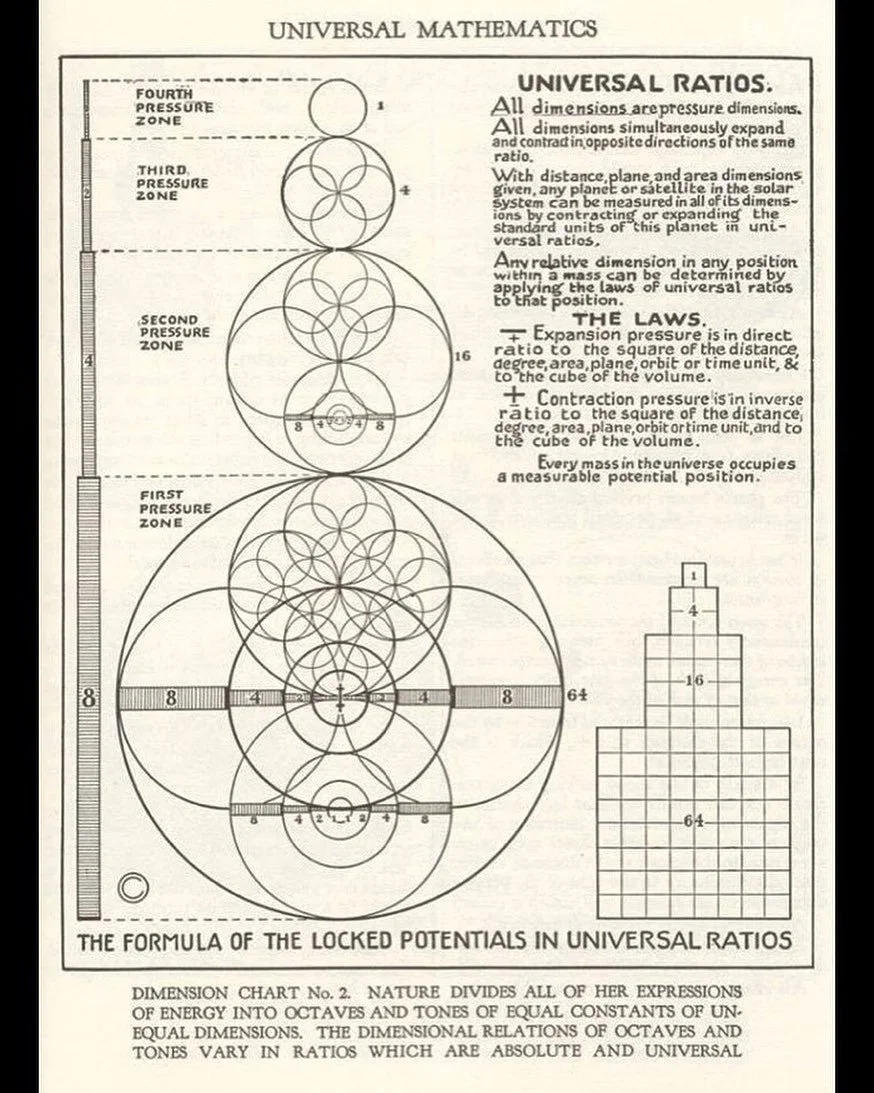
“Walter Russell's "Universal Ratios" describe the universe as a rhythmic, vibrating system of light and energy, governed by octave patterns and spiral dynamics, where matter forms from compressed light and returns to it in balanced cycles, using harmonic math (0-1-2-3-4-4-3-2-1-0) to map elements and forces, representing a unified, mind-centered cosmology distinct from mainstream physics.”
The Secret of Light
by Walter Russell
(1947; metaphysical cosmology and consciousness philosophy)
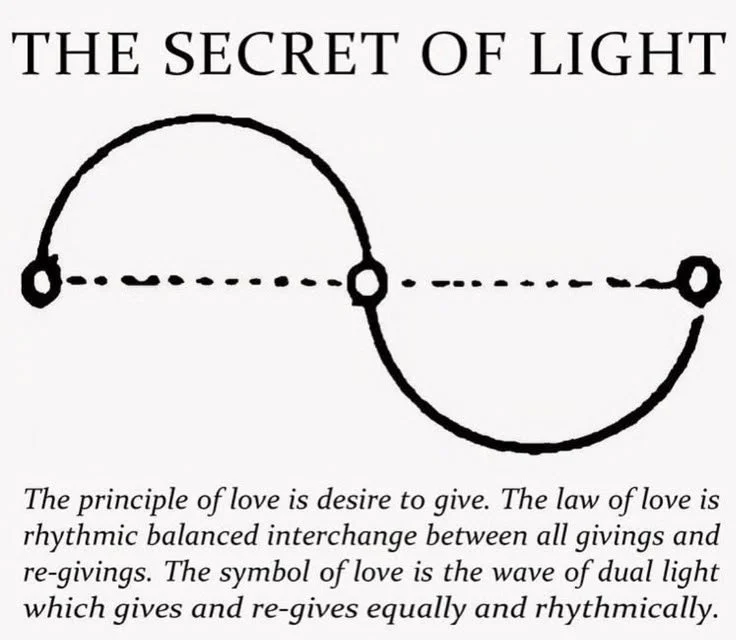
This work is Walter Russell’s most direct and accessible exposition of his central claim: that Light is the fundamental organizing principle of the universe, and that matter, motion, and form are expressions of a deeper, intelligent stillness.
In The Secret of Light, Russell:
Defines Light not merely as a physical phenomenon, but as:
The source of form
The intelligence behind motion
The still point from which all creation unfolds
Argues that:
The universe is mind-created
Matter is an effect, not a cause
Describes reality as:
A rhythmic interchange between stillness and motion
Compression and expansion
Balance and polarity
Emphasizes electricity as a universal organizing force
Presents consciousness as:
Primary
Causal
Creative
“Light is the universal One Thing from which all things come and to which all things return.”

The Lord’s Prayer
Our Father, who art in heaven,
hallowed be thy name.
Thy kingdom come.
Thy will be done
on earth as it is in heaven.
Give us this day our daily bread.
And forgive us our trespasses,
as we forgive those who trespass against us.
And lead us not into temptation,
but deliver us from evil.
For thine is the kingdom,
and the power,
and the glory,
forever. Amen.
© 2026 Illuminated Principles LLC. All rights reserved.